Showing posts with label Smartphone. Show all posts

Thursday, June 3, 2010

Smartbooks

//-->
Smartbooks
Smartbooks, the future of mobile computing?

Since the launch of the first lines of netbooks, I’ve had some concerns that they weren’t truly beneficial for mobile workers. The low battery life, lack of optical drives on some models, limited resources for programs, and their small form factor are not really conducive to mobile productivity.
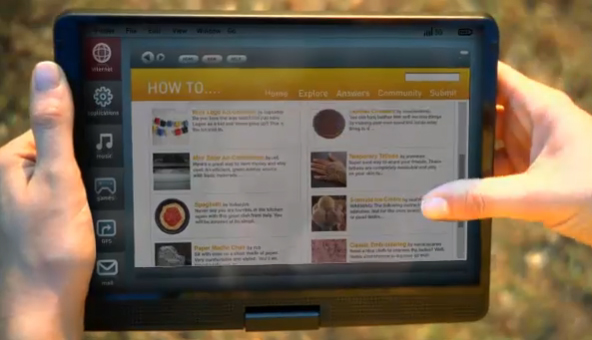
SmartbooksSmartbooks


Smartbooks just may change that perception. The target market seems to be those who need a small form factor device that can allow the user to do more than read e-mail and browse the Internet. These will be the newest twist on the netbook, mini-notebook, sub-compact design but will feature the ARM chip as opposed to Intel’s Atom chip.

SmartbooksSmartbooks


What does that mean for mobile workers? The ARM chip will provide for longer battery life (eight hours is a number being tossed around). The Smartbooks will also run on Linux instead of Windows, and is that really a bad thing?

While it is stated that the ARM chips results in lower computing power compared to the Intel Atom, software companies and developers appear to be ready to start creating applications that will take advantage of the ARM chip and still provide mobile workers with the ability to use multimedia programs.

The Smartbook name follows on the path of Smartphones which evolved from basic cell phones to mobile devices that offer the user more and hopefully better ways to be productive. We may even see Smartbooks that have removable displays to be used as a variation of an e-reader. These variations would use the Tegra chip which is another ARM product.

So no matter the name you choose to call this new mobile device you can be sure that it will change the way you can work and how well you work while traveling. It will be interesting to follow the developments and see which companies chose to get involved with making these a more robust machine.

Source: The New York Times – Bits

Monday, April 19, 2010

Ubiquitous Computing

//-->
Ubiquitous Computing
Google Building the Ubiquitous Web
By Harry Alesso


Today, while Globalization is unfolding, only 18% of the world's population is connected to the Internet. What will happen as the rest of the world becomes connected?

By 2020, it may be possible for nearly every individual to have personally-tailored access to the whole of knowledge through 'perfect search' - where the ultimate search engine can understand exactly what you mean and give back exactly what you want; anytime, anywhere.

In its quest for 'perfect search' Google could become the critical gatekeeper for connecting us to all of human knowledge; making it the leader of the Information Revolution and creating a Brave New Vision for Globalization.

The globalization of information technology began with Mark Weiser, who first identified the concept of ubiquitous computing (UC) in 1988 while he was working at Xerox's Palo Alto Research Center (PARC). Weiser described UC as the 'third wave' in computing for achieving the full potential of computing and networking.

The first wave of computing was the era of IBM, where complex mainframe computers supported large numbers of people through centralized organizations. The second wave was the era of Microsoft, where individuals and personal computing machines shared the same desktop in decentralized computing.

Today searching the Web has become an essential starting point for information access. As a result, the third wave of computing is becoming the era of Google where the information environment of each person is connected through Google to many varied devices. The key enabling technologies include the Web, wireless networking, and countless small devices which extend our personal reach from the local to a global.

The process of information retrieval consists of searching within a document collection for a particular query. In 1989 document storage, access and retrieval was revolutionized by Tim Berners-Lee when he invented the World Wide Web. Unfortunately, like the infamous Tower of Babel, much of the data on the Web remained inaccessible until 1998 when link analysis for information retrieval began to be used.

The word "Google" didn't exist before Larry Page and Sergio Brin misspelled Googol while naming their new link analysis search engine which used their PageRank algorithm.

Today, the word Google defines a 200 billion dollar company with over 25,000 employees that connects people in over a hundred languages to relevant information for free. Called "googling" the search results of over a billion searches a day includes small targeted advertisements through its 'AdWords' system; a software system that offers a self-service advertisement development capability and yields tremendous financial success for Google.

Soon however, ubiquitous computing will empower the fourth wave in computing called the Ubiquitous Web, where connected devices are automatically controlled over the Web to run financial transactions, as well as, pumps, lights, switches, sensors, monitors, and all manner of industrial machines. Google's G-phone operating system which is scheduled for release in late 2008 is its first step toward dominating the fourth wave.

While Google Earth provides satellite views for nearly very location on Earth including weather patterns and information, Google's next level of capabilities such as G-Android and G-Phone can extend to monitoring and sharing environmental data. The development of the Ubiquitous Web in coming years will permit global sensing and monitoring of many environmental parameters, such as, greenhouse gases, temperatures, water levels, ice flows, animal populations, vegetation, rainforests, weather patterns and much more. Eventually, the Ubiquitous Web connecting to billions of devices worldwide will enable us to control many environmental devices such as heat, light, pumps, etc.

Reference

Alesso, H. P. and Smith, C. F., Connections: Patterns of Discovery John Wiley & Sons, Inc. 2008.

Article Source: http://EzineArticles.com/?expert=Harry_Alesso

Saturday, April 17, 2010

Smartphone

//-->
Smartphone
Smartphone sensor could detect toxic chemicals
By Ben Coxworth

Our smartphones can already surf the Net, take photos and videos, play games, and even make phone calls, so why not... have them smell the air? That what America’s Homeland Security Science and Technology Directorate would like to see happen. The Cell-All initiative would see cell phones equipped with a sensor capable of detecting deadly chemicals. In the event of a terrorist chemical attack, the device could conceivably save numerous lives.

The chemical-sniffing chip would cost less than a dollar, and would always be working in the background, much like an antivirus program on a computer. If it detected what it perceived as a toxic chemical within its immediate vicinity, it would alert the user and/or a central station, depending on the substance in question. Alerts sent to the station would include the time of day, the phone’s location, and the name of the chemical that has been detected. An individual alert might indicate a false positive, but if the station received many simultaneous alerts from the same area, then an evacuation could be in order.

Homeland Security is currently working on a proof-of-concept study, to see just how workable the concept would be. Teams from Qualcomm, the National Aeronautics and Space Administration (NASA), and Rhevision Technology are participating in the program.

The Cell-All sensor would only be active in the phones of people who opted into the program, and alerts would be sent anonymously - conspiracy theorists, of course, might suspect otherwise.